Showing posts with label Guest Blogger Posts. Show all posts

Saturday, June 18, 2016

GUEST BLOG: “Finding the Voice in YA Fiction” by JG Faherty

Finding the Voice in YA Fiction
By JG Faherty

My latest novel (The Changeling, which I’ll talk more about later), is a YA science fiction thriller. It’s not the first time I’ve dipped my foot into the YA pool (Carnival of Fear, Ghosts of Coronado Bay, several short stories), but each time I do, it requires a radical change in my thinking. Because writing YA—effective YA, that is!—presents certain challenges I don’t normally find when I write adult fiction. Really, there are two of them:

Finding the voices of the characters
Living in the mindset of teenagers


You might think the first one is pretty easy. Watch some Buffy reruns, or binge a few seasons of Supernatural, The Vampire Diaries, or even Pretty Little Liars or Gossip Girl. But that would be a big mistake. First off, TV shows and movies use (many would say overuse) current slang and lingo that, by the time your book is written and published, will be mostly out of date, leaving you with a book that might as well sound like Fonzie and Elvis wrote it. Second, look at any successful YA novel today. Most of them use just a smattering of teen slang.

Slang should be used the same way you might build a character who’s from the South Side of Boston or the Brooklyn Heights section of New York. How often could you read sentences like: “Go pahk the cah” and “My fatha don’t botha me,” or “You, youse gonna finish dat” and “My mutta gots no friggin’ idear of dis problem heah” before you toss that book out the window?

The trick is to work a few words in here and there, mention that someone has a thick accent, and let the reader’s imagination do the rest. If you can’t accomplish that, you might need to take some classes in writing dialog. The same thing goes for slang, especially teen slang.

Sure, there are certain phrases that stick around for generations. “Cool,” for instance. My parents said it in college. I said it as a teen, and I still do. My teenage nieces and nephews say it.

But what about “Netflix and chill?” “Yo, boo?” “Hey, bae?” There’s no predicting which bits of slang will stick around for the next 10 or 20 years, and which will be so ephemeral they’re gone before your kids start school again in September.

For me, the best way to get an idea of how my teens are going to talk is to listen to teens. I listen to my relatives’ kids, my friends’ kids. I listen to teens at the mall. In the movie theater. In line at the local ice cream shop. Not only do I learn what are common phrases and what are the ones you only hear on TV, but I also pick up the nuances. How does an 18-year-old boy sound compared to a 16-year-old girl? Do they talk different around me than around their friends? What about with members of the opposite sex vs. their own cliques? Angry vs. trying to impress? How many different inflections are there to “Yo, dude” or “Hey, bitch” and what do they all mean?

And you need to have all that in your head in order to really succeed at challenge number two, living in the mindset of your characters.

Your book is going to flop if your teen heroine sounds exactly like her college-freshman boyfriend, or if they both sound like their parents. Worse, it’s not just what they say, but how they react to the things happening around them. Teenagers have quick tempers, fast reflexes, shorter attention spans. They don’t have the same years of experience in the real world to temper their reactions or give them a good basis for making logical decisions. And they have to deal with so many things we adults have forgotten about. Bullying, social acceptance, isolation, depression, 24-hour horniness, rebellion.

For each of your characters, you need to be inside their heads and determine what motivates them. Who is going to break curfew, and why? Who is going to sit in the back of the class and keep quiet? Who is going to need a sip of whiskey, or a joint, or a punch in the arm from a friend, to ask the new girl out?

No two teens are alike, even if they’re ‘besties’ and talk the same (“OMG, he said whaaaat?”) and dress the same. We tend to forget that, to think of groups of teens as clones of each other, but underneath it all they more different than adults, because they’ve not yet become conformist or resigned in their thinking about the world, they’ve not yet come to terms with their emotions.

And, don’t forget, you can’t get caught in the stereotype trap. Yes, we all know jocks, cheerleaders, nerds, outcasts, dirtbags, paste-eaters, class clowns, honor roll students, etc. And some of them do conform to stereotypes. But not all of them. And many of them, again, are only showing you the surface.

In my novel Carnival of Fear, I purposely used stereotypical characters to set up my story. Jocks vs. nerds. In-crowd vs. outcasts. Stoners vs., well, everyone. But as the book moved on, I gave them each real personalities, real problems, real emotions, showed that underneath the plastic they were very different from how the world saw them, how they wanted to be seen.

It’s called character depth, and all your characters need it, unless they are nothing but red shirts.

In my new novel, The Changeling (I told you we’d get back to it!), the main character, Chloe, is, on the surface, a self-indulgent goth chick. But we quickly see there is more to her than that. She’s a good student, balances a tight line between rebellion (drinking, dating another girl) and conformity (she’s obedient to her parents and tries not to get in trouble). As the story progresses, she has to shed her rather indolent ways and take on responsibilities she never imagined, not only for herself but for everyone she loves. And she has to do it in a way that’s realistic for a teen rather than an adult.

In that respect, The Changeling is as much a coming of age story as it is a love story or thriller. And if this interests you, you can check out an excerpt from now until June 24th, because I’m running a Kindle Scout campaign for the book.

For those of you who might not know, Kindle Scout is a program where readers are invited to preview books and vote for the ones they feel worthy of publication by Kindle Press. The benefit to you? If it wins, you get a free copy of the book for your Kindle and the book gets published. Plus, you’ll have my ever-lasting gratitude for your support (and maybe another free gift as well!). Here’s the link:


http://tinyurl.com/Changeling-scout

And here is a short summary:

THE CHANGELING is a YA sci-fi thriller in which a high school senior is the accidental target of a top-secret weapons test. Afterwards, she develops amazing powers, including seeing through walls and transporting herself through space and time. Now the Army has kidnapped her and her family so they can recreate the experiment and build an unstoppable team of invincible soldiers. It's up to Chloe to save the people she loves and put an end to the experiment. But her powers are also slowly draining her life force, and she has no idea if she'll have the strength to stop her enemies before it's too late.

I hope you’ll stop by and give it a look.


Friday, July 17, 2015

GUEST BLOG: “Sometimes Knowing is A Heavy Burden” by Jay Wilburn


So, this thing is going to be twelve books. I know because I outlined the entire mythology to see and that was the number I came up with. I don’t know every detail about every book, but I know the major story lines and events. I know who will be alive in book twelve. I know who will die before then and in which book. I’m all ready sad about some of those deaths. There is a great power in knowing the course of the series. I am purposeful with the action and when characters come onto the scene. I can do meaningful things with their actions by knowing who they are now, who they will become, and why their presence matters to the legend. There is also a burden with that.

When I introduce other elements in the story, I know where they will lead and why. I know characters that are growing in one moment, but will be pulled apart in another. Sometimes that will be spiritually and emotionally. Other times it will be physically too. There is a complexity to some of the coming villains that will make them sympathetic in ways they will not truly deserve. This will make the efforts of the heroes to stop them all the more difficult. I’m rooting for my heroes and I feel bad for the hard times that I’m finding ways to make darker and more difficult before they even begin.

Fiction serves sometimes to reflect our lives back to us in a way that allows us to look and see in ways we can’t without the lens of the fictional story. We can explore issues that we don’t know how to talk about. We can see our own hypocrisy laid bare in the actions of characters. We can hear our own prejudices and misconceptions voiced by characters in situations that allow us see through our own shortcomings. Sometimes coming to those realizations by opening ourselves to literature, even zombie stories, can bring the heavy weight of truth down onto our heads and shoulders. The truth was always there, but now we are aware of it and can really feel it in a way that we couldn’t before.

Stories can also expose our fears. It can do so in a way that helps us face them. It can let us know that they need to be faced even though we are often not anywhere ready to do so.

Knowing is a gift that often can feel like curse. There are moments in life we can look back on and realize that not knowing what was coming was a gift in the brief moment. But we also realize that ignorance was never meant to be a permanent state. Knowing brings responsibility and expectations. It pushes us to act on that knowledge as it relates to the principles we hold dear. Knowing the truth about something – anything – is an innate call to action. It is a call to begin. Realizing that you know it is time to begin something new is a burden we all must face from time to time both in fiction and in life.

***
 
Check out the latest book and music from a new series by Jay Wilburn:
 

The Dead Song Legend Dodecology Book 1: January from Milwaukee to Muscle Shoals
http://www.amazon.com/exec/obidos/ASIN/B00YDZKXCI/jaywil0d-20
 
 
The Sound May Suffer - Songs from the Dead Song Legend Book 1: January
https://itunes.apple.com/us/album/amazing-circle-of-suffering/id996569862?i=996569871&ign-mpt=uo%3D4


Jay Wilburn lives with his wife and two sons in Conway, South Carolina near the Atlantic coast of the southern United States. He taught public school for sixteen years before becoming a full time writer. He is the author of the Dead Song Legend Dodecology and the music of the five song soundtrack recorded as if by the characters within the world of the novel, The Sound May Suffer. Follow his many dark thoughts on Twitter @AmongTheZombies, his Facebook author page, and at JayWilburn.com


Monday, April 7, 2014

GUEST BLOG: Between the Interstice — On Lovecraft and Weird Fiction by Mike Robinson


"Back then, with the visions, most of the time I was convinced I'd lost it. There were other times, though, where I thought I was mainlining the secret truth to the universe."

------------ Rust Cohle, True Detective

Behind the wide facade of Speculative Fiction twist the hedge-mazes of fantasy, brood the catacombs of horror and gaze the far-seeing floors of science fiction. Among them, between them, are the closets and crawlspaces of the niche, one of which -- a relatively bigger one -- is the place of Weird Fiction, a dark storage of many souvenirs from fantasy, horror and science fiction, though dusted with its own special charms.

The former subtitle for my new book, Too Much Dark Matter, Too Little Gray: A Collection of Weird Fiction was actually, A Collection of Speculative Fiction. As one prone to appreciate sprawling ambiguity, to resist specific categorization, it’s a little ironic that I wanted to specify further. But there was a reason for that, besides the stodginess of “speculative”, which has none of the zany, fluid charisma of “weird”.
 
While using “weird” may sound like a proud judgment, a literary outcast chest-thumping his identity as such, it’s more a direct homage to the tradition of Ambrose Bierce, Robert Chambers, H.P. Lovecraft and many others. Going further, it’s an accurate classification given my vision of Weird Fiction, a subgenre that, perhaps more consciously than other fields of speculative fiction, stirs together elements of the metaphysical, cosmological and horrific to grimly honor the Big Questions, remind us of our insurmountable ignorance, to pin down our squirming selves into our rightful position in the child’s seat, to whisper, maybe in some alien, mud-packed voice, that, hey, the world slippery and you won’t ever, ever catch it. The world, in short, is weird.

And past all the horror, the strangeness, that to me is a nourishing thought. Let me explain.

The moment I cemented my decision to not pursue an M.F.A (or any academic training) in writing is vivid. While enrolled at Otis College of Art & Design, I found in my mailbox a little perfect-bound literary booklet featuring work by the graduate students in fiction. I flipped it open to a random story. After wading cautiously into the second paragraph of a painful scrutiny of eyebrow-plucking, I was done. Other entries weren’t much better. Too many of them seemed concerned with stereotypical, high-literary minutia, unfortunately the focus and baffling preference of innumerable professors, awards, journals, and workshops (cough-Iowa-cough).
My first sale, the story
The Hand of Spudd
in Storyteller Magazine

Personally, I have little interest in quaint journalistic accounts of Malaysian transvestite violinists at the turn of the century (yes, I made that up), or the endless slew of aptly-termed “McFiction” featuring some cocky narrator coming of age amongst his or her overfed, dysfunctional family. No, I prefer going head-on at the Big Questions, going at them, as George Carlin might say, with no less than a sledgehammer. Give me ballsy confrontations with Life, Death, the Cosmos, with Existence, with God.

In their noble attempts at social redemption and inclusion, many contemporary teachers of literature treat writings in the framework of their political significance. To me, though, such attempts seem nothing more than new forms of division. It is looking at the grains and forgetting the shore. Does the world really need a Marxist reading of Huckleberry Finn, complete with ten-dollar jargon? Academics are on the lookout for the “next best thing”, the new trend in analysis, the new prism through which to see literary works of yesterday and today. I say: what about our shared heritage? Our shared -- and uncertain -- future? Not as any one ethnicity, gender, party, or faction, but as an entire civilization. A species. A collective piece of this vast Universe.

Of course, much of this material is studied, and much of it is exhaustively considered and written about. Enter Weird Fiction!

As any fellow devotee will know, H.P. Lovecraft -- arguably the most esteemed and influential practitioner of the genre -- cleaned out the catacombs with his pen, defying tropes of ghosts and vampires and expanding imaginations with interconnected tales of ancient civilizations antedating our own, of towering alien-gods, of unseen dimensions and humanity’s sanity-shattering smallness in an inexplicable cosmos. All this made more impressive by the fact that he wrote in the 1920s, when so much of that stuff was barely on anyone’s speculative radar, including scientists’. His unknowns are truly Unknown, and will forever elude explanation.

Certainly Lovecraft’s work has failings, failings probably more surface-level than those of other lauded authors. He was well aware of his own wooden dialogue (hence, quotation marks are scarce in his pages) and his prose sometimes gushes into the purple. Nevertheless, his voice, with its richly archaic, darkly celebratory cadence, stands alone, and will survive as long as we’re unsure what lurks “out there”.

Me suited up, scoping “out there”
Sadly, Lovecraft, and especially his “Cthulhu” mythos, have become somewhat franchised, relegated to corners of the market generally aimed at Dungeons and Dragons fans, horror enthusiasts, and nihilistic young adults sporting black fingernails and lipstick. It is a wide “cult following”, but nonetheless a cult following. Although some scholars have acknowledged his importance, many see him as a troublesome bridge from Poe to Stephen King. It is this identity that has, I’m sure, dissuaded many from giving him a serious go. “Lovecraft? Oh, no, I don’t like that horror stuff.”

But back up. Here we come back to the question of Weird Fiction itself, because I don’t necessarily consider the canon, or Lovecraft’s work, “horror”. Certainly there are horrific elements in his work, and his career does include several standard supernatural yarns. But in his treatment of cosmic mysteries, and the shadowed realms of prehistory, his is more a prying curious eye, forcing us to consider those Big Questions, to ponder notions of, and issues with, the likes of religion, biology, cosmology, archaeology, and psychology. He sets you on the outside looking in, a contrast to being in and looking further in to the point of navel-gazing. This exercise of outside-looking-in, one I believe most writers of fiction should undertake, helps in a kind of rounding out of thought.

No matter the genre in which one writes, I believe the best, most poignant stories have at least an undercurrent of this “larger awareness”, a perception conveying authority and wisdom. So many stories feel constricted by their own world, characters or concerns. Yet to read Lovecraft is to confront directly that raw Unknown that surrounds us, that is us. To get a healthy dose of perspective: a shambling, roaring, behemoth upswell of perspective.

I mentioned earlier that I think such a perspective can be ultimately nourishing. In an era of economic, cultural and political tumult, when millions of Davids the world over shout in fiery voice against the few far-reaching, corrupt Goliaths, there is morbid comfort in knowing that, despite whatever the megalomaniacal egos of sadistic leaders, immoral bankers, or bribe-pocketing politicians might make of themselves, there are impenetrable forces beyond all of them that will cast mocking eyes towards their suited-up, gold-rimmed delusions, if they even care to acknowledge them. Lovecraft, and the general tradition of Weird Fiction, reminds us just how little power the powerful actually wield. After all, Goliath was, what, ten feet tall? When the mountain-sized Cthulhu rises once more, those people will be nothing but scrambling ants -- along with the rest of us.

***
 
Find and follow Mike Robinson at: 

Amazon:
http://www.amazon.com/Mike-Robinson/e/B009RDLX7K/ref=ntt_athr_dp_pel_pop_1


Facebook:
https://www.facebook.com/MikeRobinsonAuthor?ref=hl


Sunday, November 4, 2012

GUEST BLOG: “What the Hell is That?” Writing Contemporary Horror Fiction by Mike Robinson

A friend of mine tells the story of when he was ten years old and lying in bed. He was having trouble sleeping, and so tossed and turned well into the deep redeye hour, that time when, regardless of location, the primal country of our ancestors seems most palpable. As he finally started to drift off, he felt a tug on the sheet, then heard a voice (“Gruff,” he explains, “like a grown man”) whisper harshly into his ear, “Scoot over!”

Sleep never came that night and, whether ghostly or imagined, the cold-fingered memory still grips his spine.

Or take my younger years. One Christmas Eve, after watching the George C. Scott version of A Christmas Carol, I sat in bed, wide awake. I’m sure I was joined by millions of others my age, but it wasn’t the anticipation of presents keeping me up. It was the damn Ghost of Christmas Future, who I expected any moment to come drifting down the hallway to my room. I wanted to close my eyes, but was too afraid I wouldn’t see him coming, and so would snap awake to a tall robed figure looming bedside, pointing its long skeletal index finger at me.
 
It’s difficult for me to believe that one can write truly effective horror -- horror that feels organic, new and authentic -- without some variation of this wonderful “fright gene.” And while many kids get scared, I’d venture to guess it’s a minority that actually craves such experiences, and would as an adult classify them as ‘wonderful.’ They’re frightening at the same time they’re uplifting, texturing the world in rich, noble insanity. I still have them, too, to some degree. They’re baked into the cake. For whatever reason, my brain works often in perverse entertainment to unnerve itself, like when I lie awake in the dark, on my side, and think, “I’m alone right now. What would happen if I felt a light tap on my shoulder?”
 
This gusto for goosebumps, this knack for nightmare, is, I believe, a formative and fundamental part of writing good horror fiction, fiction that is borne of an innate, ongoing process, and not just relegated to Halloween. Such a mindset also encourages originality, because for you the tropes and stock creatures and boardroom frights have come and gone, and you’re out scouring murkier fathoms.
 
By no means am I insinuating that horror writers belong to some exclusive club that asks potential members to list their childhood terrors for approval. I’m merely saying it helps incalculably if that hungry fascination, both celebrated and unsettling, runs in your DNA.
 
Take a novelist acquaintance of mine. For years she wrote romance and erotic fiction. Successfully, I might add. But one day she became interested in trying horror, “because it always sells.” I was skeptical -- I thought she should no more write horror than I should romance. But hey, I’m open-minded (truly I am), so my reply never went beyond a nod and some words of wooden encouragement.
 
Her result, while well-written and passable, was largely what I expected: a paint-by-numbers retread of typical genre fare. She didn’t have it in her blood, nor had she sopped up enough of the genre to know what was overrun and what awaited better exploration. Her approach was artificial, mechanical (not helped by the dollar signs in her eyes). I’d seen such things as hers, and had yawned past them. And yet, decades-old work by the greats, which I’ve read and re-read, continue to chill. Stephen King said horror must regularly renew itself, or die. H.P. Lovecraft, Richard Matheson and Clive Barker are some of last century’s revitalizing visionaries. Who’s holding the defibrillators this century? Why not you?
 
We’ve all heard the mantra that the heart of horror is fear of the unknown. Increasingly, however, that truism is more acknowledged than executed. Since the 1980s publishing bust, when oversaturation proved the genre’s downfall, horror has limped on, like a transient ambling down the road, pitied by faces watching from curtains of snug homes. Dark Fantasy took it in, as has Paranormal. YA has sucked up some of it. It’s been broken down and mixed in with other genres. This is partly why we’ve seen the resurgence of tropes like vampires, werewolves and zombies, all of which hardly represent “the unknown,” not any longer. They’re well known, and so, in this author’s opinion, not very scary.
 
Some of the best inspiration for those looking to break this rut can be found not necessarily in mainstream books but in the thousands of utterly bizarre reports posted everyday in archives and message boards of websites catered towards strange phenomena. Even documentary-style TV shows like Paranormal Witness can offer up good fodder. Whether you believe these people or not, it’s for sure that nothing can be as weird as reality. And I don’t just mean Victorian-garbed girls fading into thin air, or Sasquatch strutting through the brush. Consider the following example of a man who, while living in the jungles of Hawaii, was invited to dinner by a neighboring couple, Tom and Anne, whom he’d always considered nice, but odd. He goes on to explain:
 
“One night .... I was over at their house as usual and was sitting at the table having some food and conversation. I was eating, looking down at my plate. Tom and Ann were saying something. All of a sudden, like a switch went off, they stopped talking in mid sentence. I looked up from my plate, across the table at Tom and Ann next to him and I saw them there, as if frozen in time. Their mouths wide open with their eyes and their mouth’s completely black. And I don’t mean normal black. I mean a deep, empty black. Blacker than any black you’ve ever seen your life. Almost like another dimensional black. Their mouths as black as their eyes. You could feel the black (if that makes any sense).
 
I was immediately struck with a sense of fear. As I stood up and looked at them, I couldn’t believe what I was seeing. I wasn’t high, I wasn’t drinking, I was just seeing something that I couldn’t understand. I contemplating running through that dark jungle full of fear to get home. When everything returned to normal, like a light switch turned back on, as if nothing happened at all.”
 
There’s another report in England of a couple encountering, early in the morning, what they called a “stickman,” a flat, silhouetted humanoid they compared to the logo on the door of a Men’s public restroom. It’d been “lolly-hopping,” was their term, until it stopped, realizing they could see it.
 
Those are just two of an infinite number of examples. I bring these up not to revel in weirdness, but to suggest how deep and dark those unexplored fathoms can be. So grab a flashlight! And of course, while I tack towards the supernatural, or extraordinary, keep in mind horror does not have to be physically inexplicable, though it does involve something inexplicable, like the who or why of the creepy (and very earthly) home invaders in the underrated film The Strangers.
 
Most really good horror fiction also, for me, is like a solar system. In the center pulses the Central Big Idea or Image, which nourishes the smaller ones orbiting it. Of course, this can be seen in other genres (notably theme-layered literary fiction), but I feel it’s particularly significant with horror. It’s usually the image or idea that starts the juices flowing, that spools out the rest of the story. It’s the image that, when successfully realized, will survive in your readers’ minds (and dreams) long after the closing passage. Think of The Shining, for instance, and you think of a murderous father pursuing his wife and son.
 
My forthcoming horror novel The Prince of Earth began with the image of a young woman injured and alone atop a misty mountain in the middle of the Scottish Highlands, where she is plagued by a malevolent force. To me, it was a powerful aesthetic vision, and the progenitor of all else that came after it. And this image wasn’t attached to any specific idea. Oftentimes, the idea, or ideas, are built into the image, and it’s your job to decode them and discover them, unearthing the morbid delights in that visual package.
 
If it’s not entirely obvious, I’m not a big outliner. I realize this is subjective, and in all fairness I have been known to what I call “micro-outline” a certain section or chapter I’m having trouble with. Every writer should do what they feel works for them. But when it comes to horror, a genre that relies on suspense, surprise, underlying trepidation of what’s around the corner, I’m mildly suspicious of outlining. If you as the author are the first to take the journey of your story, unsure yourself what lurks out there (or within), that shows in the result. It gives the book a heartbeat, a greater sense of intrigue, doubt and wonder. If the tale is more or less composed as a “Fill in the Blanks with Scare A, B, C,” or a connect-the-dots exercise, it tends to dilute the reading experience.
 
And, of course, if your Big Image proves too big for an outline, it may just break its cage, maul your mind and tell you other ways of doing things. And wouldn’t that also be a wonderful experience?
 
 
***
 
 
Mike Robinson has been writing since age 7, when his story Aliens In My Backyard! became a runaway bestseller, topping international charts (or maybe that was also just a product of his imagination). He has since published fiction in a dozen magazines, literary anthologies and podcasts. His debut novel, Skunk Ape Semester, released by Solstice Publishing, was a Finalist in the 2012 Next Generation Indie Book Awards.
 
Currently he’s the managing editor of Literary Landscapes, the official magazine of the Greater Los Angeles Writers Society (glaws.org). His supernatural horror/mystery novel The Green-Eyed Monster is now available from Curiosity Quills Press.
 
Link to Amazon Purchase Page:

 
Link to Mike Robinson’s Author Page:

Friday, April 27, 2012

GUEST POST from Raymond Masters - Thoughts On Writing

My name is Raymond Masters, and I'm a self-published author. That doesn't have nearly the same connotation as it did when I first started writing. In fact, indie and self-published writers are quickly becoming the standard. The internet is full of stories and advice from professionals and semi-pros. I am neither of those; I am but a humble beginner. Of course, it really doesn't take long to amass a list of – let's not call it advice – helpful hints to pass along to those in the same boat as I am. So, this is for the beginners or those considering writing.

The thing about writing, as they say, is to write every day. If you want to be a writer, then write. Don't wait around for the perfect time to put pen to paper or fingers to keyboard. That perfect time rarely presents itself. Just do it. Have ten extra minutes? Jot down some notes or the opening paragraphs of your next scene. Why? It's hard to get back into the swing of things, once you've taken a break from it. I'm living proof of that. I love writing and have so many ideas to tell that I have to kick myself whenever there's a gap in my writing. It's not always easy. This is especially true for indie or self-published writers. Life doesn't stop – or even slow down for that matter – just because you have this awesome story to unwrap.

You can also sequester yourself in an office or your bedroom and close the door. It's okay; it's not anti-social. This lets others know this is not the time for socializing. This is your work time. Or it can be your "you" time. If you do this daily and form a routine, this accomplishes a couple of things. It not only gets your family used to the fact that you're going to be writing for an hour or two each day, but it also will speed you up as a writer. You won't require as long to get into that magical zone.

Get plenty of rest. It's funny to throw this in there, but your body and mind really need to be recharged thoroughly for the best results. Of course, there are some exceptions, but if you're writing something you wish to control, get a good night's sleep the night before. If you're doing your own edits, then you'll have a lot fewer "What?" moments down the line.

Take breaks. Get up and stretch your mind while you're stretching your legs. Some of my best ideas have come to me while walking, showering, or resting. It's because your mind has permission to wander off. But, and here's the thing, it won't be wandering too far, since you're writing daily. Your subconscious will be researching your story while you're doing some of the most mundane tasks of your day. Just be sure not to take a weeks-long break, as I said, or your mind will grow bored and move onto something new and shiny.

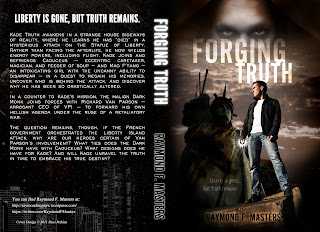
And, speaking of shiny, I hope you did, indeed, find my hints to be helpful. These are all ideas that I put into play while writing Forging Truth. Forging Truth is the first book of The Truth Saga. I am currently working on its sequel Corrupting Truth. If you're interested in good fun and character-driven stories, you may wish to check out the below links.

Thank you, so much for tagging along. And a very special thank you to Eric for helping me to Spread the Truth.

Take care,
Raymond


Where to find Forging Truth: